
THE PROBLEM
Engineering leaders can't prove ROI.
AI is making it worse.
Your tools show velocity, tickets closed, PRs merged. None of that answers the question in every board deck: “What did engineering actually deliver for the business?”
Activity metrics ≠ capital impact
Jira and GitHub tell you what shipped. They don't tell you whether it moved the needle — or what type of capital it consumed.
AI 10×'d the output, not the insight
With AI-assisted development, teams ship 10x more code. The capital allocation blind spots are now 10x larger too.
Governance is always late
By the time you realize you spent 80% of the quarter on structural work, the quarter is over. Retrospective governance doesn't change outcomes.
ENGINEERING CAPITAL
Initiatives aren't projects.
They're capital containers.
Engineering capital is the accumulated value your team builds over time. Every initiative allocates that capital into one of six types. InnerOrbit tracks the allocation — so you govern where your capital actually goes, not where you planned it to go.
Revenue Capital
Initiatives expected to grow or protect top-line revenue.
Cost Capital
Investments that reduce operating costs or improve efficiency.
Risk Capital
Work that reduces technical, security, or compliance exposure.
Experience Capital
Improvements to developer experience and team productivity.
Capability Capital
Building new technical capabilities or platform foundations.
Structural Capital
Architecture investments that enable future scale and speed.
HOW IT WORKS
Not a dashboard.
An AI agent.
InnerOrbit doesn't wait for you to log in. It monitors, classifies, governs, and reports — continuously.
Connects via MCP
Integrates with Jira, GitHub, Linear, and your analytics stack through the Model Context Protocol — no webhooks, no fragile ETL.
Classifies in Real-Time
Every initiative is automatically classified by capital type. Allocations update as work progresses, not at quarter-end.
Enforces Governance
Allocation targets, approval gates, and escalation rules run automatically. Governance happens at the point of work, not in retrospect.
Monitors Drift
When allocation drifts from targets — say, too much structural capital, not enough revenue — InnerOrbit alerts before it becomes a board conversation.
Generates Board Reports
Ask for a board-ready capital allocation summary. Get it in seconds, not a two-week data pull. "Show me Q2 capital allocation by type" — done.
Answers Other AI Agents
Your AI coding assistants, planning agents, and ops bots can query InnerOrbit for governance context. It's the system of record for engineering capital.
SEE IT IN ACTION
Capital governance,
visualized.
From executive dashboards to AI-powered analysis — see how InnerOrbit governs your engineering capital.
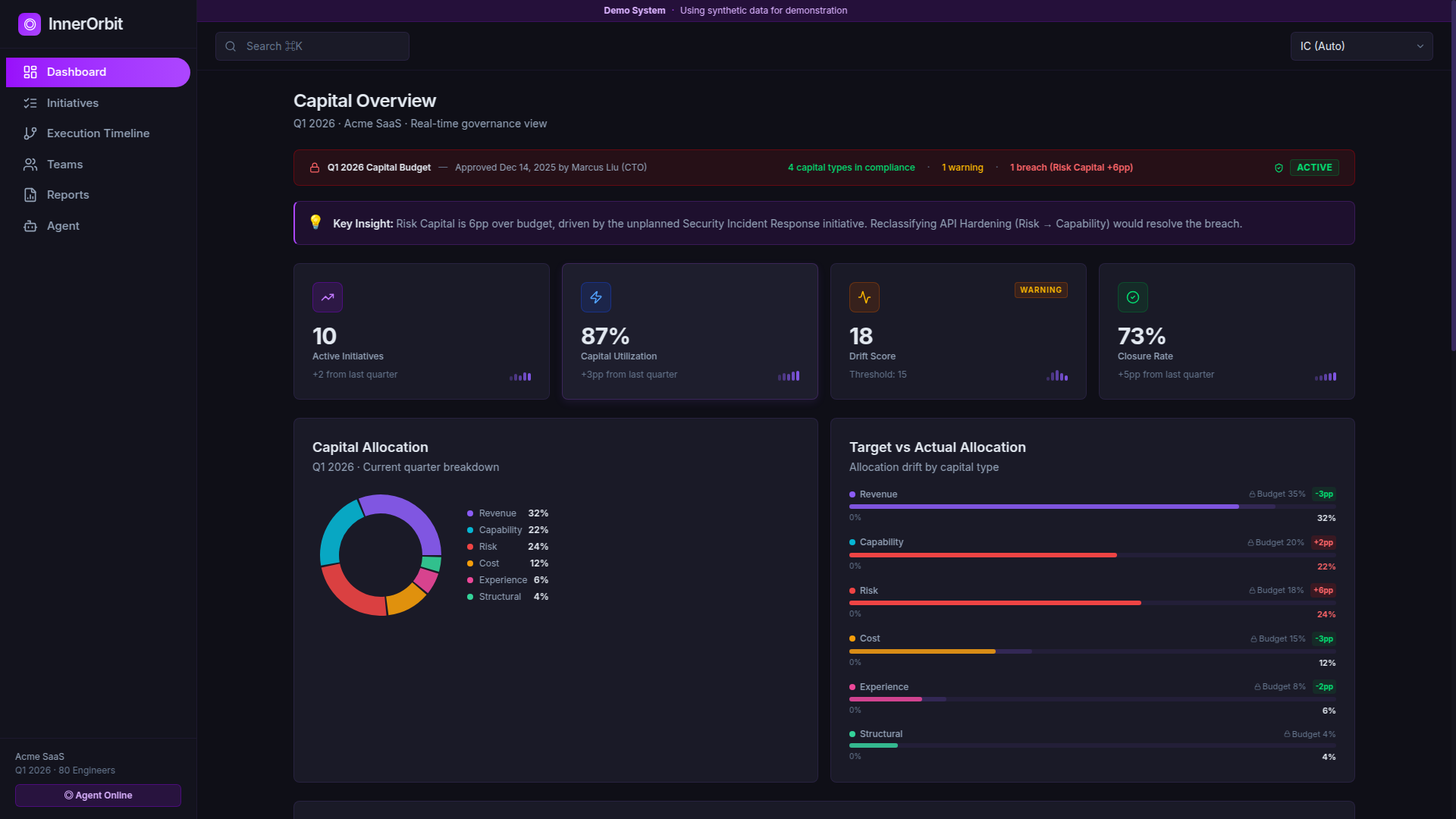
Capital Allocation Dashboard
Real-time view of engineering capital deployment. See budget compliance, drift monitoring, and AI-recommended rebalancing — all in one view.
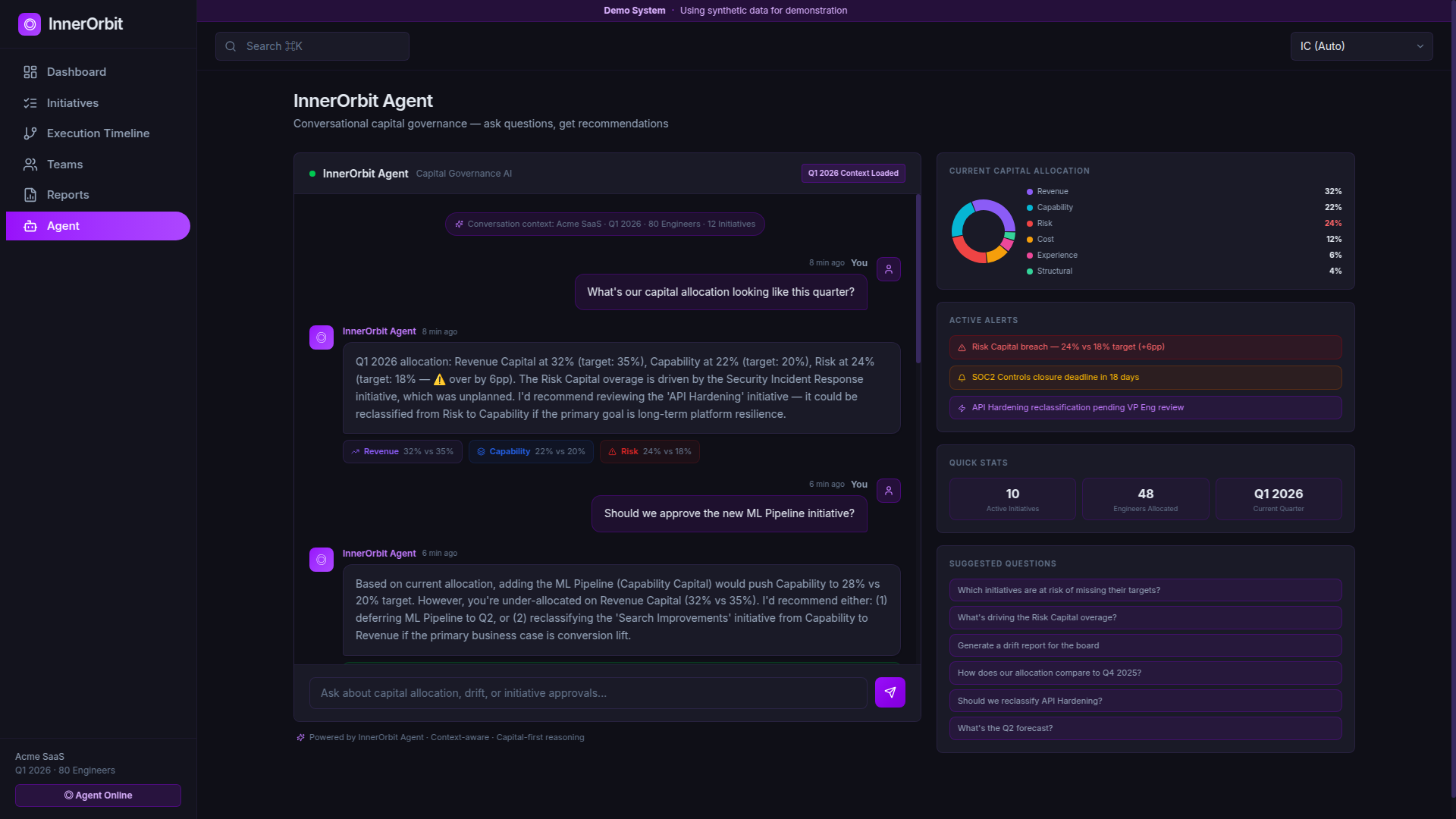
AI Governance Agent
Ask questions about capital allocation, get portfolio-aware recommendations, and simulate the impact of new initiatives before approving them.
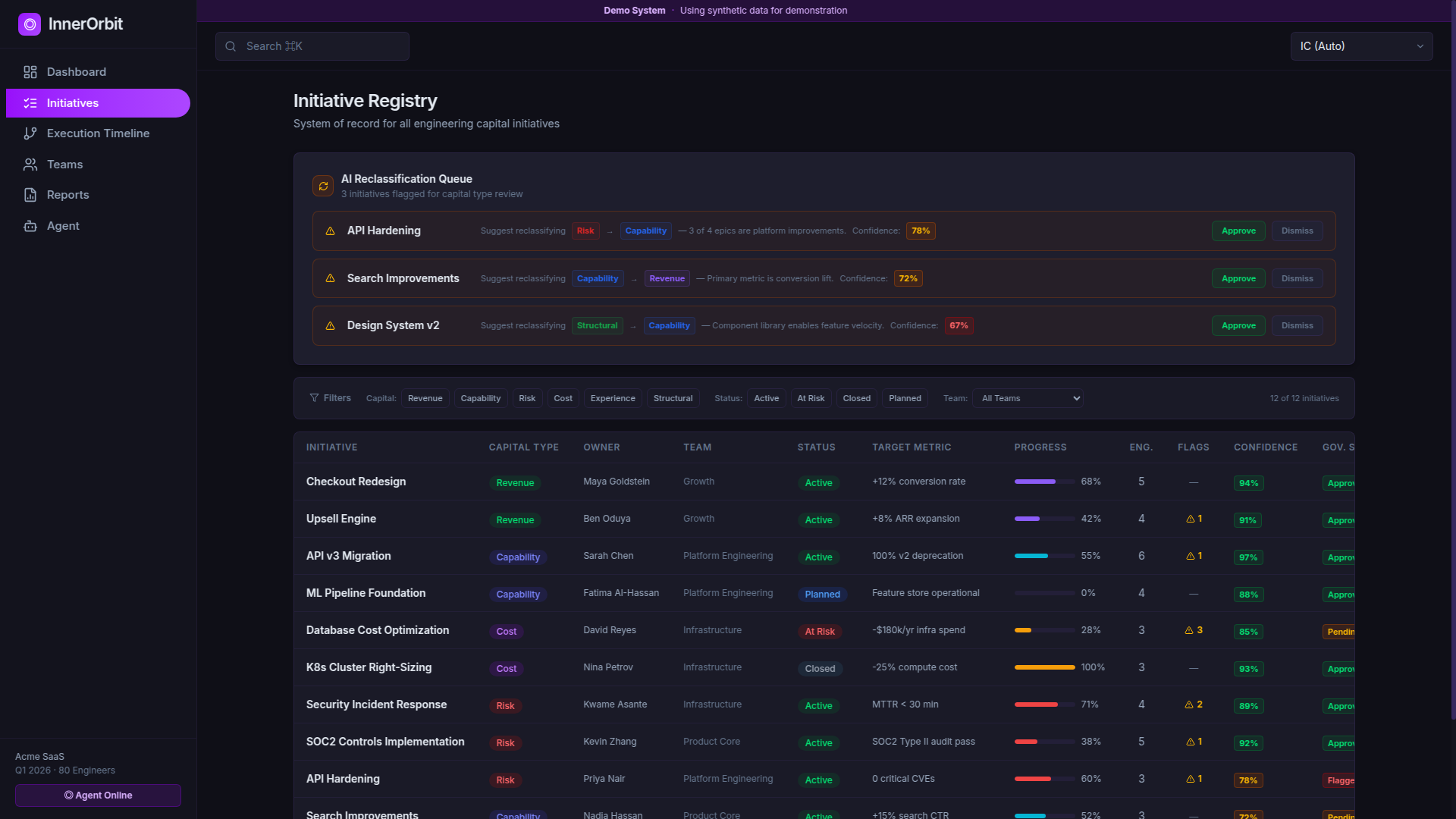
Initiative Registry with AI Classification
Every initiative classified by capital type with AI confidence scores. The reclassification queue surfaces governance actions that need your attention.
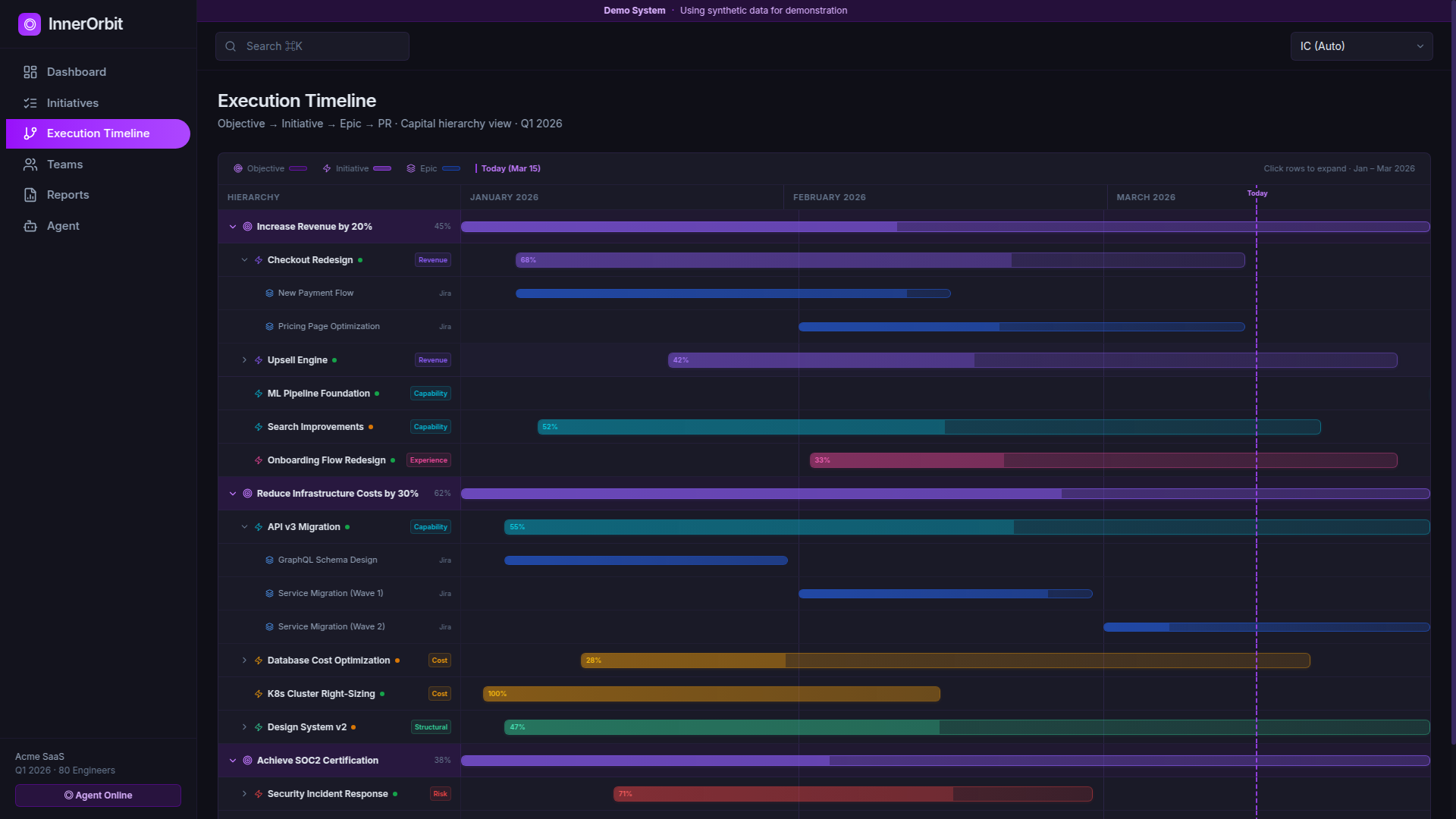
Execution Timeline
Gantt-style view from Objectives to PRs. Track capital deployment across the quarter with real-time progress, drift indicators, and Jira integration.
WHY AGENT-FIRST
Dashboards are a
dead end.
In 2026, AI agents can query data directly. The question isn't “how do we build a better dashboard?” It's “what system of record will AI agents trust?”
InnerOrbit survives because it's not a display layer — it's a decision layer and governance system of record. Other agents query it. Humans query it. The board queries it.
Your engineering team's AI assistants will ask InnerOrbit “what capital type does this initiative fall under?” before making decisions. That's a governance model that actually scales.
- –Login required
- –Data goes stale
- –You pull reports
- –No governance logic
- →Always running
- →Real-time classification
- →Push alerts on drift
- →Governance at the point of work
BUILT FOR PRIVACY
Your data never leaves
your cloud.
InnerOrbit is deployed in your VPC. It uses your own LLM instance — AWS Bedrock, Azure OpenAI, or self-hosted. We never see your engineering data, your initiatives, or your capital allocation. This is not a SaaS dashboard. It's an agent you own.
Self-Hosted in Your VPC
Deploy on your own Kubernetes cluster or EC2.
Your LLM Instance
AWS Bedrock, Azure OpenAI, or bring your own.
Zero Data Egress
Engineering data never leaves your environment.
Enterprise Compliance
SOC 2 ready. Works with your existing controls.
EARLY ACCESS
Get early access to
InnerOrbit.
We're onboarding a small cohort of engineering leaders. Early access includes hands-on onboarding and direct input on the product roadmap.